
|
Explore the application of handheld analyzers in the stainless steel industryStainless steel refers to steel that is resistant to corrosion by weak corrosive media such as air, steam and water, as well as chemical corrosive media such as acids, alkalis and salts. It is also known as stainless acid-resistant steel. The content of different alloy components in stainless steel has a significant impact on the corrosion resistance, high-temperature oxidation resistance and mechanical strength of stainless steel. The basic alloying elements of stainless steel include Fe, Cr, Ni, Mn, Mo, N, Cu, Nb, Ti, Si and other elements. Different proportions and compositions are used to meet the requirements for the microstructure and properties of stainless steel for different applications. The following takes the commonly used stainless steels 304 and 316 in our production and life as examples to introduce the application of handheld alloy analyzers in the rapid detection of stainless steel grades.
304 stainless steel, also known as 18/8 stainless steel, has the GB grade of 06Cr19Ni10. 316 stainless steel is also a widely used steel grade, with the GB grade of 022Cr17Ni12Mo2. It is mainly used in the food industry and surgical instruments. The addition of molybdenum gives it a special structure that is resistant to corrosion. 316 contains a higher content of nickel and molybdenum alloys, which makes its price higher than that of 304. In actual trade, it is difficult to quickly distinguish different types of steel grades, which may cause significant losses to users and also bring certain product quality and even safety hazards. In actual production and life, due to the difficulty in distinguishing 316 and 304 stainless steel in appearance and the fact that conventional analysis methods are rather cumbersome and time-consuming, the handheld alloy analyzer is a portable spectrometer specifically designed for on-site use. It can quickly, non-destructively and accurately provide information on the composition, content and grade of stainless steel materials. It is very suitable for on-site screening and re-inspection of a large number of raw materials and products.
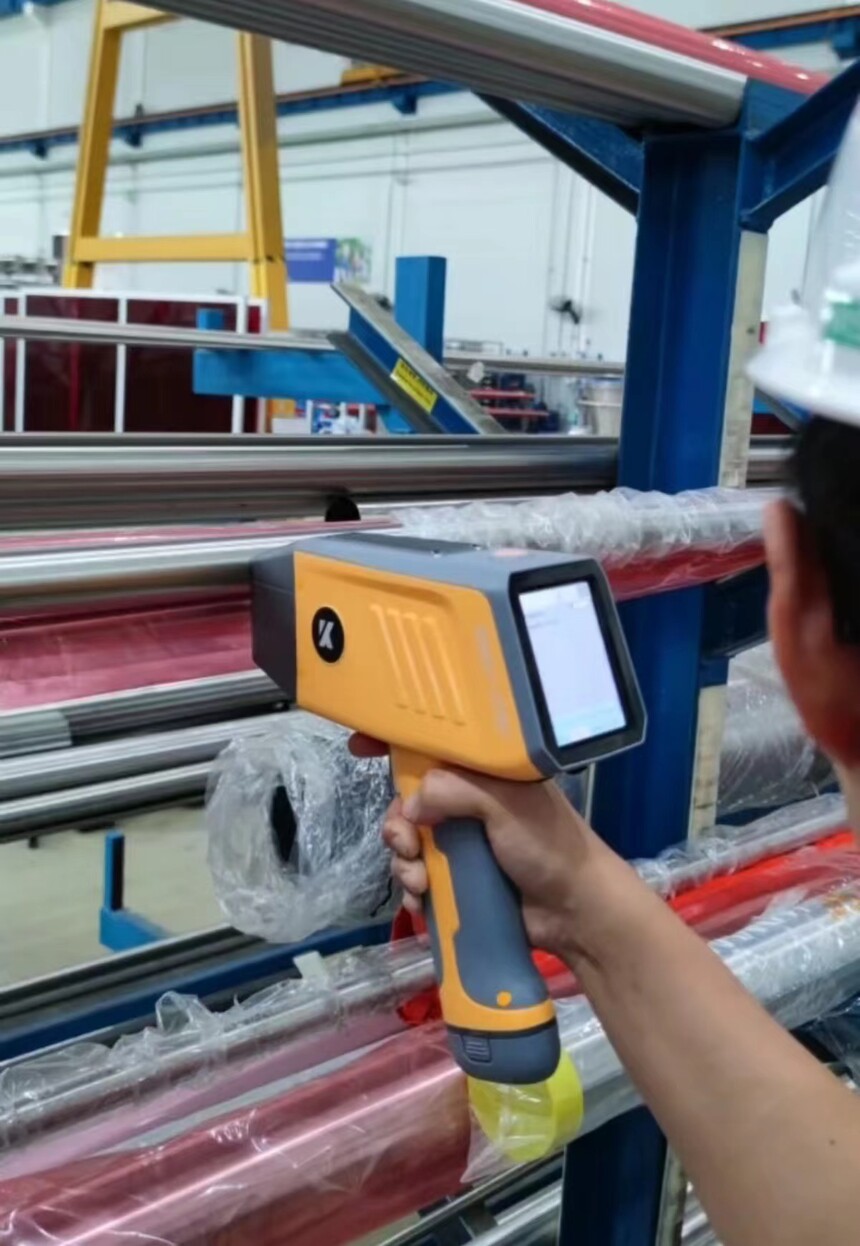
The KMX-RAY K-8000 alloy analyzer can non-destructively, rapidly and accurately analyze and detect alloy elements and identify alloy grades on-site. Rapidly analyze the content of more than 29 elements ranging from titanium (Ti) to uranium (U). I. Product Application 1.It is used for on-site non-destructive, rapid and accurate analysis and detection of alloy elements and identification of alloy grades. 2. Rapidly analyze the content of more than 29 elements ranging from titanium (Ti) to uranium (U). Ii. Product Features 1.One-click foolproof operation, eliminating complex operation options, effectively preventing human error operation; 2. The software exits and shuts down automatically. (Users can customize the shutdown time) 3. Automatically calibrate the instrument without manual operation; 4. It only takes 45 seconds from startup to testing, and the alloy grade and data are available in 2 seconds. 5. Multi-national data card database (China, the United States, Japan, Russia, France, Germany) Iii. Product Parameters 【 Weight 】 Basic weight :1.6kg, with battery attached :1.65kg 【 Dimensions (Height x Width x Length)】250mm x 75mm x 270mm(length * width * height) 【 Excitation Source 】 The standard target material for the ray tube is silver (Ag) or tungsten (W). 【 Voltage, Current and Power 】 High-power miniature X-ray tube 35KV, 100MA, 4W; 【 Filter 】 Aluminum filter sheet 【 Detector 】 High-performance and high-resolution Si-Pin X-ray detector; 【 Detector Cooling Temperature 】 Peltier effect semiconductor cooling, cooling temperature -35℃; 【 Standard Piece 】 The external 316 standard cap is equipped with a test window protection function; 【 Resolution 】<190ev 【 Power Supply 】8 hours /2 lithium power supplies and AC power supply; 【 Processor 】Intel 400MHz StrongArm processor 【 Operating System 】 Mobile Windows CE 6.0 System 【 Software Standard Mode 】 Alloy Mode 【 Data Processing 】32G large-capacity data storage card: ≥ 40,000 groups of data and spectral graphs; 【 Data Analysis 】 Multiple analysis modes, including basic parameters, Compton normalization, and empirical calibration mode; 【 Data Display 】 Concentrated on ppm and percentage (%) display, spectral or peak intensity (count rate) or user-specified units 【 Data Transmission 】USB bidirectional interface for data transmission; 【 Display Screen 】 Color, high-resolution 3.5-inch TFT industrial-grade touch screen, large icon graphical interface, clearly visible under any lighting conditions; 【 Design 】 Integrated body design, sturdy, waterproof, dustproof, frost-proof, effectively shock-proof, suitable for use in outdoor, damp or low-temperature environments; 【 Safe Operation 】 One-touch "trigger", the software automatically locks the trigger at regular intervals or automatically stops the test protection function; The X-ray will be automatically turned off within 2 seconds after it is determined that there is no sample in front of the test window. 【 Test Environmental Conditions 】 Temperature -20 to +50℃, humidity < 80%RH; The instrument has been calibrated before leaving the factory. However, the instrument still has the function of establishing targeted calibration curves, which is suitable for precise testing of specific samples. 【 Result Report 】 The instrument is equipped with a standard Type-c interface and Bluetooth wireless transmission, which can directly transfer data to a computer or network storage device. Measurement data and their X-ray spectra can be directly downloaded in a customized EXCEL format. User permissions can be set, customized reports can be generated and analysis reports can be printed. 【 Radiation Protection Function 】 Within the space range of 10 to 100 cm from the instrument handle to the instrument casing, the radiation dose rate is less than 2.5μSv/h. 【 Elemental content analysis Range 】 From 0.01% to 99.99%; Iv. Design Features of the Instrument 1.High-performance Si-Pin detectors are adopted, which have higher detection accuracy. 2. Achieve on-site, rapid, non-destructive and accurate detection, and display the alloy grade, elements and percentage content within 2 seconds. 3. The adoption of 4W X-ray tube technology enables the instrument to have both better detection limits and radiation safety guarantees. 4. The multi-beam light technology (Smart Beam) is adopted, and the software automatically selects the beam band according to the element content. 5. The lower detector temperature and the ultra-low temperature operation state of -35℃ enable the instrument to have outstanding resolution. 6. Higher detection accuracy. The average value statistics function of multiple tests can effectively improve the detection accuracy of the instrument. 7. Intelligent detection of irregular or very small samples, such as hair (0.06MM) filaments, can also be tested and identified immediately. 8. Automatic stop function: If there is no object to be tested in front of the window, the instrument will automatically stop the test after 2 seconds when it is started. 9. The extendable probe can be used to inspect the inner walls of pipes, welds, small components and other positions that are usually difficult to reach. 10. The instrument is equipped with a high-definition resolution display screen, allowing for free viewing and editing of test information and results on site. 11. Alloy grades can be added, edited and deleted on site without the need for a computer. 12. The instrument is made of aluminum alloy, which has stronger heat dissipation capacity, anti-vibration ability and an automatic anti-radiation safety device. 13. It adopts a humanized one-button design, so users do not need to keep pressing the button during the testing process. 14. The test results can be connected to a computer for output and printing. The instrument has a standard version of the test results, which greatly facilitates customers in editing and printing the result information. 15. The instrument can achieve remote monitoring function. Maintenance engineers can install the instrument software and perform maintenance functions remotely via the Internet, ensuring that the customer's machine does not break down 24 hours a day. 16. The instrument adopts the Windows CE6.0 operating system to ensure that the instrument's operating system is more stable and has more powerful functions. 17. The instrument is equipped with standard blocks. Each time it is turned on, the instrument automatically standardizes. Only when the standardization is passed can the instrument be used normally. If the standardization is not passed, the instrument cannot be used. Ensure that the instrument is within the normal accuracy guarantee range each time it is used. 18. The instrument adopts the basic parameter Method (FP Method). Before testing, there is no need to know the type of test sample or select the test curve. 19. The test results can be converted into Excel output, or directly transferred to a personal computer or a laptop via Bluetooth for printing and output, and archived. There is a slot-type heat dissipation device on the top of the instrument. The entire system makes heat dissipation very effective, extends the machine's lifespan, and makes the X-ray analyzer work more stably, thus having an extremely low failure rate. |