
|
X-ray Fluorescence Analysis Method (Theoretical Edition)X-ray fluorescence analysis (XRF) Generally, X-ray fluorescence analysis is classified into energy dispersive X-ray fluorescence analysis (EDXRF) and wavelength dispersive X-ray fluorescence analysis (WDXRF) based on the differences in the spectrometric systems. Although EDXRF and WDXRF both belong to X-ray fluorescence analysis, there are significant differences in their principles and instrument structures, as well as obvious variations in their functions and performances. A thorough understanding of the principles and structures of these two types of X-ray fluorescence spectrometers is extremely necessary for the selection of spectrometers. Today, the editor will take you to understand the basic principle and instrument structure of energy dispersive X-ray fluorescence analysis. 1. Basic Theory of EDXRF
X-rays are a type of short-wavelength electromagnetic radiation, with wavelengths ranging approximately from 0.01 to 10 nanometers. There are mainly three ways X-rays are generated: electron deceleration, electron transition, and electron direction change. (1) Electron deceleration: When free electrons moving at high speed enter the interior of an atomic nucleus and interact with the outer electrons of the nucleus that are also negatively charged, it causes the electrons to decelerate, thereby generating X-rays. This type of X-ray is a kind of X-ray with continuous energy, also known as bremsstrahlung radiation. (2) Electron transition: When electrons outside the atomic nucleus transition from a higher energy level to a lower one, X-rays are produced. These X-rays are characteristic X-rays carrying information about the atomic nucleus. That is, the X-ray energy has a fixed energy. (3) When the movement direction of free electrons changes, high-energy X-rays are produced. The simplest way to generate X-rays is to strike a metal target with accelerated electrons, which is also a common excitation source for X-ray tubes. During the impact process, electrons suddenly decelerate, and the lost kinetic energy is released in the form of photons, forming a continuous part of the X-ray spectrum, which is called toughening radiation (braking radiation). By increasing the accelerating voltage, the energy carried by electrons increases, and it is possible to knock out the inner electrons of metal atoms. So holes are formed in the inner layer, and electrons from the outer layer transition back to the inner layer to fill the holes, while emitting photons with a wavelength of about 0.1 nm. Because the energy released by the transition of outer electrons is quantized, the wavelengths of the emitted photons are also concentrated in certain parts, forming characteristic lines in the X-ray spectrum, which is called characteristic radiation. 2. Principles of qualitative analysis
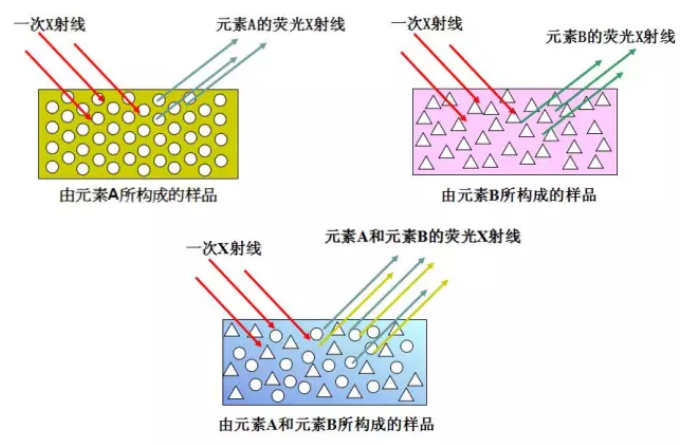
In the figure, after X-ray irradiation of the samples composed of elements A and B, A and B will produce X-ray fluorescence with different characteristic energies. By distinguishing the magnitudes of the characteristic energies, it is possible to identify which elements A and B are. Principle of Quantitative analysis
In the figure, after X-ray irradiation of the samples composed of elements A and B, the higher the content of element A, the stronger the X-ray fluorescence intensity of element A. Generally, the intensity of X-ray fluorescence is linearly related to its content. 2. Structure of EDXRF instrument
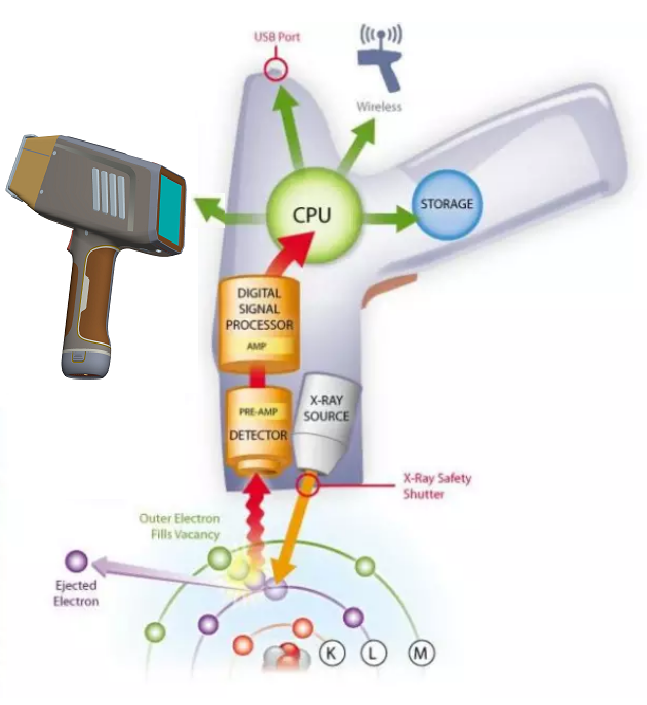
Component parts: The energy dispersive X-ray fluorescence spectrometer is mainly composed of X-ray tubes, X-ray detectors, multi-channel analysis systems and other major components. Functions of the main components: X-ray tubes are used to generate primary X-rays that excite the characteristic fluorescence of samples. The detector performs photoelectric conversion on the characteristic fluorescence of X-rays. The multi-channel analysis system performs integral statistics on electrical signals with different pulse amplitudes. The light tube, detector and multi-channel analysis system, as the core components of the X-ray fluorescence spectrometer, have a significant impact on the overall performance of the machine. The unique X-ray micro-tube technology of KXM-RAY enables the test tube voltage to reach 50 KV, effectively enhancing the excitation efficiency of heavy elements. Meanwhile, combined with the German Ketek SDD detector, the detection efficiency is 10 times that of the Si-Pin detector and 3 times that of the ordinary SDD detector. Light elements such as magnesium (Mg), aluminium (Al), silicon (Si), phosphorus (P), and sulfur (S) can be detected under conditions without helium purging and vacuum assistance.
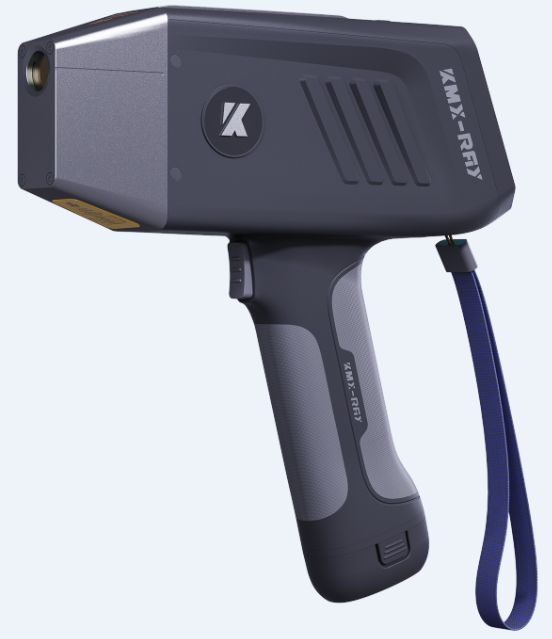
The evaluation method for the "quality" of EDXRF instruments The performance of the instrument Precision and stability are important technical indicators that buyers need to evaluate. For different testing requirements, select the testing instruments that meet their requirements. Application direction For laboratory testing or complex applications, it is recommended to use a desktop X-ray fluorescence spectrometer. Benchtop fluorescence devices employ high-power X-ray tubes and are also equipped with vacuum or He-filling systems. Some instruments are also fitted with spin or automatic injection functions. It has good scalability for different applications. On-site in-situ detection The handheld X-ray fluorescence spectrometer has built measurement modes into the instrument for different applications, eliminating the need for customers to expand them further. Customers only need to clarify the type of their test samples to select the appropriate model. Brand and After-sales Service The brand of the instrument and after-sales service are also factors that buyers cannot ignore. High-quality after-sales service can make buyers use the equipment more at ease. The KMX-RAY handheld X-ray fluorescence spectrometer is characterized by its light weight, portability, simple operation and wide application range. It is widely used in the identification of alloy materials, ore exploration, soil heavy metal screening, RoHS testing and other fields. |